








Verbo to be no presente, passado e futuro: tabela completa
Am, is, are no presente, was e were no passado, will be e going to be no futuro: o verbo to be em uma tabela só, com negativa, perguntas, a tradução para ser e estar, os erros mais comuns de brasileiros e três exercícios com respostas.
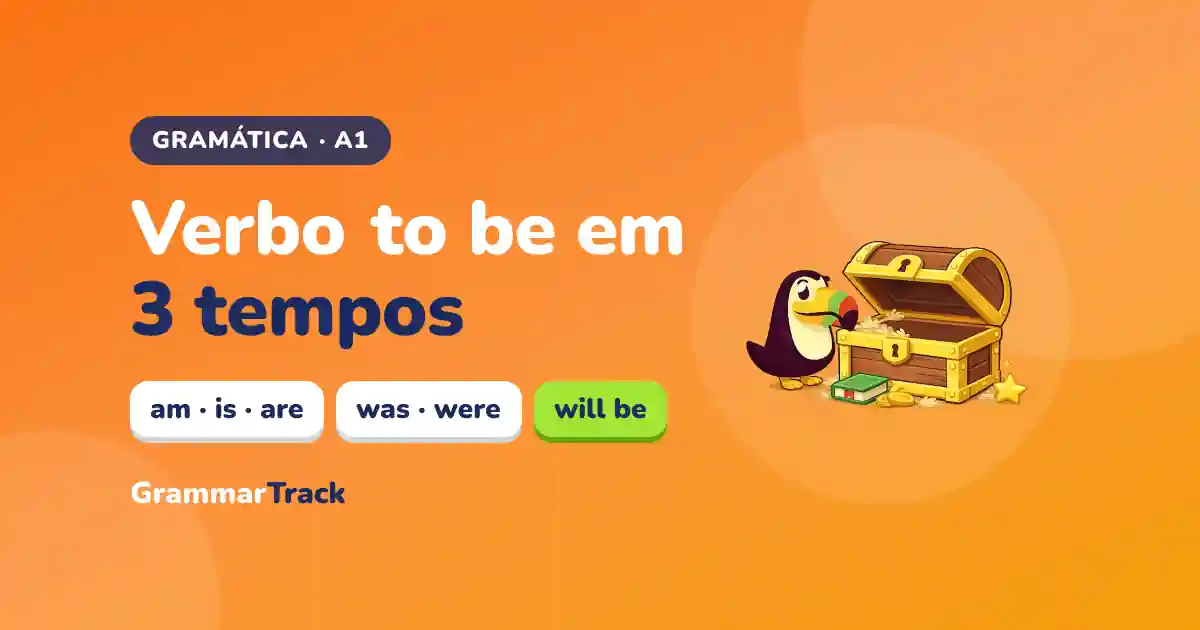
O verbo to be muda conforme o tempo: no presente ele é am, is ou are; no passado, was ou were; no futuro, will be (ou going to be), igual para todas as pessoas. Em português, ser e estar têm dezenas de formas (sou, estou, era, estava, fui, estive, serei, vou estar...). Em inglês, as mesmas ideias cabem em uma tabela de cinco linhas. Abaixo você encontra a tabela completa do verbo to be no presente, passado e futuro, as frases afirmativas, negativas e interrogativas de cada tempo, como passar uma frase de um tempo para outro, os erros mais comuns de brasileiros e três exercícios com respostas.
1.Tabela do verbo to be no presente, passado e futuro
| Sujeito | Presente | Passado | Futuro com will | Futuro com going to |
|---|---|---|---|---|
| I | I am (I'm) | I was | I will be (I'll be) | I am going to be (I'm going to be) |
| you | you are (you're) | you were | you will be (you'll be) | you are going to be (you're going to be) |
| he, she, it | she is (she's) | she was | she will be (she'll be) | she is going to be (she's going to be) |
| we | we are (we're) | we were | we will be (we'll be) | we are going to be (we're going to be) |
| they | they are (they're) | they were | they will be (they'll be) | they are going to be (they're going to be) |
Repare como o número de formas diminui de um tempo para o outro:
- Presente: três formas. Am só com I, is com he, she e it, are com you, we e they.
- Passado: duas formas. Was com I, he, she e it, were com you, we e they. Com you, é sempre were, mesmo falando com uma pessoa só.
- Futuro: uma forma. Will be serve para todos os sujeitos. No futuro com going to, quem muda é o am, is ou are que vem antes de going to; o be no final fica igual.
Como traduzir cada tempo
| Tempo | Em inglês | Em português |
|---|---|---|
| Presente | I am tired. I am a student. | Eu estou cansado. Eu sou estudante. |
| Passado | I was tired. I was a student. | Eu estava cansado. Eu era estudante (ou: fui estudante). |
| Futuro | I will be tired. I will be a student. | Eu vou estar (estarei) cansado. Eu vou ser (serei) estudante. |
A escolha entre ser e estar não muda nada no inglês: a forma depende só do sujeito e do tempo. Quando a dúvida é a tradução (é ou está?), veja a tabela de ser ou estar no verbo to be.
2.Afirmativa, negativa e interrogativa nos três tempos
A mesma frase, Ela está em casa, nos três tempos e nas três formas:
| Tempo | + Afirmativa | - Negativa | ? Interrogativa |
|---|---|---|---|
| Presente | She is at home. | She isn't at home. | Is she at home? |
| Passado | She was at home. | She wasn't at home. | Was she at home? |
| Futuro (will) | She will be at home. | She won't be at home. | Will she be at home? |
| Futuro (going to) | She**'s going to be** at home. | She isn't going to be at home. | Is she going to be at home? |
A lógica é a mesma nos três tempos, e nenhum deles usa do, does ou did:
- Negativa: o not entra logo depois da primeira palavra do verbo: is not (isn't), was not (wasn't), will not (won't). A forma contraída de will not é won't, não willn't.
- Interrogativa: só a primeira palavra do verbo passa para antes do sujeito. No futuro, o be fica depois do sujeito: Will she be at home?, e não Will be she at home?
Respostas curtas
| Pergunta | Sim | Não |
|---|---|---|
| Are you ready? | Yes, I am. | No, I'm not. |
| Were they at the party? | Yes, they were. | No, they weren't. |
| Will you be at home tonight? | Yes, I will. | No, I won't. |
| Is it going to be cold? | Yes, it is. | No, it isn't. |
Na resposta curta afirmativa não existe contração: Yes, I am e Yes, I will, nunca Yes, I'm ou Yes, I'll.
3.Verbo to be no presente: am, is, are
O presente é o único tempo com três formas, e é nele que estão as frases do dia a dia: I'm hungry (Estou com fome), She's 20 (Ela tem 20 anos), It's hot today (Está calor hoje), We're from Recife (Somos de Recife). Repare que idade, fome, frio e calor usam to be em inglês, não have.
A conjugação completa com tradução, a escolha entre ser e estar e exercícios com gabarito estão na página verbo to be no Present Simple (presente simples).
4.Verbo to be no passado: was e were
No Past Simple (passado simples), era, estava, foi e esteve viram todos was ou were, conforme o sujeito:
- A festa foi ótima. = The party was great.
- Eles estavam em casa. = They were at home.
- Eu era tímido quando criança. = I was shy as a child.
Cuidado com o foi que vem do verbo ir: Ele foi à praia é He went to the beach, não He was to the beach. Para havia e tinha no sentido de existir, use there was e there were. Os detalhes, os erros comuns e um exercício com gabarito estão em verbo to be no passado: quando usar was e were.
5.Verbo to be no futuro: will be e going to be
O futuro é a parte em que o brasileiro mais tropeça, porque o português tem duas formas (serei e vou ser), e o inglês também tem duas, mas elas não correspondem uma à outra.
Will be
Estrutura: sujeito + will + be. O will nunca muda (nada de wills), e depois dele o verbo to be fica sempre na forma be, para qualquer sujeito.
- I**'ll be** at home after six. (Vou estar em casa depois das seis.)
- Tomorrow will be a long day. (Amanhã vai ser um dia longo.)
- She**'ll be** 15 in March. (Ela vai fazer 15 anos em março.)
- Don't worry, it won't be difficult. (Não se preocupe, não vai ser difícil.)
- Will you be at the meeting? (Você vai estar na reunião?)
O Future Simple (futuro simples) completo, com outros verbos além de to be, está na página Future Simple com will.
Going to be
Estrutura: sujeito + am, is ou are + going to be.
- I**'m going to be** a vet. (Vou ser veterinária.)
- It**'s going to be** a hot weekend. (Vai fazer calor no fim de semana.)
- They aren't going to be happy about this. (Eles não vão ficar felizes com isso.)
- Are you going to be at home on Sunday? (Você vai estar em casa no domingo?)
Não esqueça o be: I'm going to be a doctor é "Vou ser médico", mas I'm going to a doctor soa como "Vou a um médico". Na fala, going to costuma virar gonna (It's gonna be fine), forma que você vai ouvir em músicas e séries, mas que não se usa em textos formais. A estrutura completa está em going to: futuro com planos e intenções.
Will be ou going to be?
Para previsões, as duas formas costumam funcionar: It will be cold tomorrow e It's going to be* cold tomorrow* dizem a mesma coisa. A diferença aparece em dois casos:
| Use | Quando | Exemplo |
|---|---|---|
| will be | promessa, decisão tomada na hora, fato do futuro | I'll be there at eight, I promise. (Vou estar lá às oito, prometo.) |
| going to be | plano já decidido, previsão baseada no que você vê agora | Look at the queue. It's going to be a long wait. (Olha a fila. Vai demorar.) |
Para treinar essa escolha com outros verbos, veja will ou going to.
"Vai ter" no futuro: there will be
Em português, vai ter uma festa usa o verbo ter. Em inglês, a ideia de "existir" é there is e there are, que no futuro viram there will be, igual no singular e no plural:
| Tempo | Singular | Plural |
|---|---|---|
| Presente | There is a party. | There are two parties. |
| Passado | There was a party. | There were two parties. |
| Futuro | There will be a party. | There will be two parties. |
Com going to: There's going to be* a party on Saturday.* Não diga Will have a party nem It will have a party.
Quando eu estiver, se eu for: sem will
Depois de quando, se e assim que, o português usa o futuro do subjuntivo: quando eu estiver em casa, se estiver frio. O inglês usa o presente nesses casos, mesmo falando do futuro:
- Quando eu estiver em casa, te ligo. = When I'm home, I'll call you. (não: When I will be home)
- Se estiver frio, a gente fica em casa. = If it's cold, we'll stay home.
- Assim que você estiver pronto, a gente sai. = As soon as you're ready, we'll leave.
O will aparece só na outra parte da frase. É a mesma regra da first conditional.
6.Como passar uma frase do presente para o passado e o futuro
- Encontre o am, is ou are da frase.
- Passado: troque am e is por was, e are por were.
- Futuro: troque am, is ou are por will be (ou won't be na negativa).
- Ajuste as palavras de tempo: today e now viram yesterday, last week, ou tomorrow, next week.
| Presente | Passado | Futuro |
|---|---|---|
| I'm tired today. | I was tired yesterday. | I**'ll be** tired tomorrow. |
| We're in Salvador this week. | We were in Salvador last week. | We**'ll be** in Salvador next week. |
| They aren't at school today. | They weren't at school yesterday. | They won't be at school tomorrow. |
| Is the shop open now? | Was the shop open yesterday? | Will the shop be open tomorrow? |
| There are two buses today. | There were two buses yesterday. | There will be two buses tomorrow. |
7.Been e being: as outras formas do to be
As três formas principais do verbo são be, was/were, been, como em qualquer lista de verbos irregulares. Além delas, existe being.
- Been (particípio) aparece no Present Perfect: I have been to Salvador twice (Já estive em Salvador duas vezes), She has been sick since Monday (Ela está doente desde segunda). Para o que começou no passado e continua agora, o inglês usa have been, não o presente: I have been here since Monday, e não I am here since Monday.
- Being (gerúndio) é o "estar sendo", um comportamento só daquele momento: You are being very kind today (Você está sendo muito gentil hoje).
O to be também serve de auxiliar (auxiliary) antes de um verbo com -ing: I was studying (Eu estava estudando) é o Past Continuous, e I'll be working* at ten* (Vou estar trabalhando às dez) é o Future Continuous.
8.Erros comuns de brasileiros com o verbo to be
| Errado | Certo | Por quê |
|---|---|---|
| I will to be there. | I will be there. | Depois de will, o verbo vem sem to. |
| She will is happy. | She will be happy. | Depois de will, sempre be. |
| I will be go to the party. | I will go to the party. | Com outro verbo, o be sai: "vou à festa" não tem estar. |
| I will have 18 years next month. | I**'ll be** 18 next month. | Idade usa to be em todos os tempos: "vou fazer 18 anos". |
| Will have a party on Saturday. | There will be a party on Saturday. | "Vai ter" no sentido de existir é there will be. |
| I'm going to a doctor. (= vou ser médico) | I'm going to be a doctor. | Sem be, a frase vira "vou a um médico". |
| When I will be in London, I'll call you. | When I'm in London, I'll call you. | Depois de when e if, o inglês usa o presente. |
| Will be the shop open tomorrow? | Will the shop be open tomorrow? | Só o will vai para antes do sujeito. |
| Yes, I'll. | Yes, I will. | Resposta curta afirmativa não se contrai. |
| You was right. | You were right. | Com you, sempre were. |
| I didn't was at home. | I wasn't at home. | To be não usa did. |
| Yesterday I was go to the beach. | Yesterday I went to the beach. | Was não entra antes de outro verbo no passado. |
9.Exercícios de verbo to be no presente, passado e futuro
Três exercícios com respostas: complete com a forma certa, passe as frases para o passado e o futuro e traduza frases que costumam confundir brasileiros.
Exercício 1. Complete com am, is, are, was, were ou will be
Olhe as palavras de tempo (yesterday, now, next year) para escolher o tempo certo.
- Yesterday ___ my birthday.
- My parents ___ in Fortaleza now. They love it there.
- Next year I ___ 16.
- ___ you at the gym last night?
- Don't worry, the test ___ easy tomorrow.
- It ___ very cold in Curitiba last winter.
- I ___ hungry. Can we eat now?
- The tickets ___ expensive last year, but now they ___ cheap.
- ___ there ___ a party at school next Friday?
- We ___ late yesterday because of the traffic.
Respostas do exercício 1 (clique para ver)
1: was2: are
3: will be ('ll be)
4: Were
5: will be
6: was
7: am ('m)
8: were, are
9: Will, be (Will there be a party...?)
10: were
Exercício 2. Passe para o passado (yesterday) e para o futuro com will (tomorrow)
- I'm at home today.
- She isn't at work today.
- Are they at school today?
- It's sunny today.
- There are a lot of people at the beach today.
- Is your brother busy today?
Respostas do exercício 2 (clique para ver)
1: I was at home yesterday. · I'll be (I will be) at home tomorrow.2: She wasn't at work yesterday. · She won't be (will not be) at work tomorrow.
3: Were they at school yesterday? · Will they be at school tomorrow?
4: It was sunny yesterday. · It'll be (It will be) sunny tomorrow.
5: There were a lot of people at the beach yesterday. · There will be a lot of people at the beach tomorrow.
6: Was your brother busy yesterday? · Will your brother be busy tomorrow?
Exercício 3. Traduza para o inglês
- Amanhã vai fazer calor.
- Vai ter um show no parque no sábado.
- Eu vou fazer 20 anos em julho.
- Quando eu estiver em São Paulo, vou te visitar.
- Ela estava cansada ontem.
- Você vai estar em casa hoje à noite?
- Nós não fomos à aula. Estávamos doentes.
- Eu vou ser professora.
Respostas do exercício 3 (clique para ver)
1: It will be hot tomorrow. (ou: It's going to be hot tomorrow.) A frase precisa do sujeito it.2: There will be a concert in the park on Saturday. (ou: There's going to be a concert...) Nada de will have.
3: I'll be 20 in July. (ou: I'm going to be 20 in July.) Idade usa to be.
4: When I'm in São Paulo, I'll visit you. Depois de when, presente.
5: She was tired yesterday.
6: Will you be at home tonight? (ou: Are you going to be at home tonight?)
7: We didn't go to class. We were sick. Fomos vem de ir, por isso didn't go; estávamos é to be, por isso were.
8: I'm going to be a teacher.
10.Próximo passo
Errou algo no presente ou no passado? Cada tempo tem uma folha para imprimir com gabarito: os exercícios do verbo to be no presente em PDF (am, is, are) e os exercícios do verbo to be no passado em PDF (was, were, there was, there were). Para o futuro, pratique com áudio e correção na hora nas páginas Future Simple e going to.
Com o to be dominado, o próximo passo são os outros verbos, que precisam de do, does e did: veja simple present: afirmativa, negativa e interrogativa.