








Esercizi mixed conditional con soluzioni (periodo ipotetico misto)
Come si forma il periodo ipotetico misto in inglese e quando serve? Le due combinazioni in una tabella, come tradurre tempo per tempo dall'italiano, gli errori tipici e cinque esercizi con soluzioni, anche misti con i tipi 0, 1, 2 e 3.
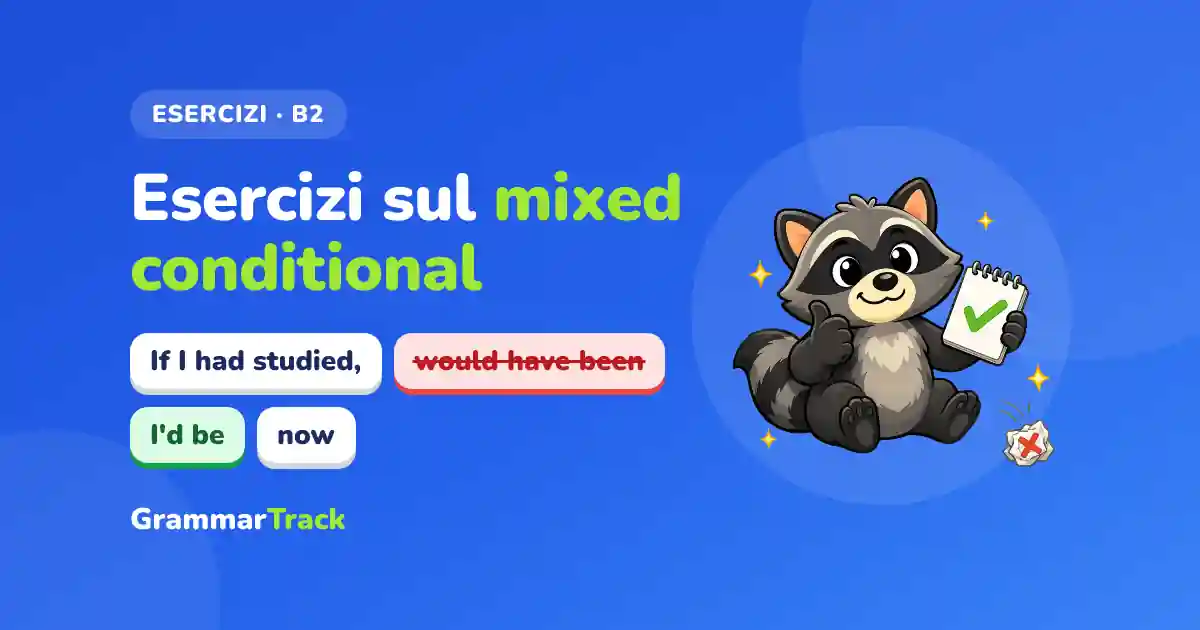
Il mixed conditional (in italiano periodo ipotetico misto) mescola due momenti diversi: la condizione riguarda un tempo, la conseguenza un altro. If I had taken that job in Milan, I would live there now. La condizione è nel passato (non ho accettato il lavoro), la conseguenza è nel presente (non vivo a Milano). La buona notizia per chi parla italiano: anche noi mescoliamo i tempi allo stesso modo («Se avessi accettato quel lavoro, ora vivrei a Milano»), quindi qui la traduzione tempo per tempo funziona quasi sempre. Gli errori nascono altrove: dal would messo dopo if, dall'imperfetto colloquiale («se lo sapevo, venivo») e dall'abitudine di usare il third conditional ogni volta che si parla del passato.
Qui sotto trovi la regola in una tabella, un ripasso veloce dei quattro tipi di periodo ipotetico, tre domande per scegliere il tipo giusto, gli errori tipici degli italiani e cinque esercizi con soluzioni: due solo sul mixed conditional e tre misti, con frasi di tipo 0, 1, 2, 3 e misto da completare, correggere e tradurre.
1.Mixed conditional: le due combinazioni in una tabella
| Combinazione | Condizione (if) | Conseguenza | Esempio |
|---|---|---|---|
| Passato → presente (tipo 3 + tipo 2) | if + past perfect | would + forma base | If I had studied medicine, I would be a doctor now. (Se avessi studiato medicina, ora sarei medico.) |
| Presente → passato (tipo 2 + tipo 3) | if + past simple | would have + participio passato | If I were braver, I would have spoken to her at the party. (Se fossi più coraggioso, alla festa le avrei parlato.) |
Passato → presente: if + past perfect, would + forma base
È la combinazione più frequente. Un fatto del passato che non è andato così, e la sua conseguenza oggi:
- If we hadn't missed the train, we would be in Florence now. (Se non avessimo perso il treno, ora saremmo a Firenze.)
- If she had saved some money, she wouldn't be in debt today. (Se avesse risparmiato qualcosa, oggi non avrebbe debiti.)
- If I had gone to bed earlier, I wouldn't feel so tired. (Se fossi andato a letto prima, non sarei così stanco.)
Al posto di would puoi usare could (possibilità) o might (forse): If he had learnt English at school, he could apply for that job now. (Se avesse imparato l'inglese a scuola, ora potrebbe candidarsi per quel lavoro.) Se la conseguenza è un'azione in corso, va bene anche la forma in -ing: If I had accepted the offer, I would be working in London now. (Se avessi accettato l'offerta, ora lavorerei a Londra.)
Presente → passato: if + past simple, would have + participio passato
Qui la condizione è una situazione sempre vera, come un tratto del carattere o un fatto stabile, e la conseguenza è un fatto passato che non è avvenuto:
- If Marco weren't so stubborn, he would have apologised yesterday. (Se Marco non fosse così testardo, ieri si sarebbe scusato.)
- If I spoke German, I would have understood the instructions. (Se parlassi tedesco, avrei capito le istruzioni.)
- If she didn't hate flying, she would have come to New York with us. (Se non odiasse volare, sarebbe venuta a New York con noi.)
Con be, nella condizione si usa were con tutte le persone (If I were, If he were), proprio come il congiuntivo «se fossi». If I was e If he was si sentono spesso nel parlato; in un esame scrivi were.
Gli indizi nella frase
Di solito il mixed conditional si riconosce dalle parole di tempo. Now, today, still, by now e anymore nella conseguenza indicano il presente; yesterday, last year, at the party e when I was a child indicano il passato. Se nella conseguenza c'è now, non può essere un third conditional: ✗ If I had studied, I would have been a doctor now. ✓ If I had studied, I would be a doctor now.
2.Ripasso: i quattro tipi di periodo ipotetico (0, 1, 2, 3)
Il mixed conditional prende un pezzo dal tipo 2 e un pezzo dal tipo 3. Prima degli esercizi misti, ecco tutti i tipi insieme:
| Tipo | Condizione | Conseguenza | Quando si usa | Esempio |
|---|---|---|---|---|
| Zero conditional (periodo ipotetico di tipo zero) | if + present simple | present simple | verità generali, regole, abitudini | If you heat ice, it melts. (Se scaldi il ghiaccio, si scioglie.) |
| First conditional (periodo ipotetico della realtà) | if + present simple | will + forma base | una condizione possibile nel futuro | If it rains tomorrow, we'll stay at home. (Se domani piove, restiamo a casa.) |
| Second conditional (periodo ipotetico della possibilità) | if + past simple | would + forma base | una situazione immaginaria nel presente o nel futuro | If I had more time, I would learn the guitar. (Se avessi più tempo, imparerei la chitarra.) |
| Third conditional (periodo ipotetico dell'irrealtà) | if + past perfect | would have + participio passato | un passato che non è andato così | If you had told me, I would have helped you. (Se me l'avessi detto, ti avrei aiutato.) |
| Mixed conditional (periodo ipotetico misto) | if + past perfect oppure if + past simple | would + forma base oppure would have + participio | condizione e conseguenza in due momenti diversi | If I had charged my phone, I could call a taxi now. (Se avessi caricato il telefono, ora potrei chiamare un taxi.) |
Ogni tipo ha una pagina con spiegazioni, video ed esercizi interattivi: zero conditional per le verità generali, first conditional con if e will, second conditional e If I were you e third conditional per i rimpianti sul passato. Tutti e quattro sono raccolti nel corso sul periodo ipotetico inglese: zero, first, second e third.
3.Come scegliere il tipo giusto: tre domande
- La condizione è reale o immaginaria? Se può succedere davvero (domani può piovere), è un tipo 0 o 1. Se è contraria alla realtà (non ho vinto alla lotteria, non sono andato alla festa), è un tipo 2, 3 o misto.
- Quando si colloca la condizione? Nel presente, o è sempre vera: if + past simple. Nel passato: if + past perfect.
- Quando si colloca la conseguenza? Nel presente o nel futuro: would + forma base. Nel passato: would have + participio passato.
Poi combina le risposte 2 e 3: presente + presente è il tipo 2, passato + passato è il tipo 3, passato + presente oppure presente + passato è un mixed conditional.
Proviamo con «Se non fossi allergico ai gatti, avrei adottato il gattino di Sara». La condizione è sempre vera (sono allergico): if I weren't allergic. La conseguenza è nel passato (non l'ho adottato): I would have adopted. Risultato: If I weren't allergic to cats, I would have adopted Sara's kitten.
4.Dall'italiano all'inglese: tempo per tempo
Su questo argomento l'italiano è un alleato, perché il nostro periodo ipotetico usa le stesse combinazioni. Basta questa corrispondenza:
| Italiano | Inglese | Esempio |
|---|---|---|
| se + congiuntivo imperfetto (se fossi, se avessi) | if + past simple | se parlassi → if I spoke |
| se + congiuntivo trapassato (se fossi stato, se avessi avuto) | if + past perfect | se avessi saputo → if I had known |
| condizionale presente (sarei, vivrei) | would + forma base | ora vivrei → I would live now |
| condizionale passato (sarei stato, avrei vissuto) | would have + participio passato | avrei capito → I would have understood |
Così «Se avessi studiato (congiuntivo trapassato), ora sarei (condizionale presente) medico» diventa If I had studied (past perfect), I would be (would + forma base) a doctor now. Due avvertenze. Il condizionale passato italiano si forma con essere o con avere, mentre in inglese è sempre would have: sarei arrivato → I would have arrived. E potrei e avrei potuto diventano could e could have + participio: Se fossi partito prima, avresti potuto vederla. → If you had left earlier, you could have seen her.
Il past perfect della condizione (had studied, had known) è lo stesso tempo che usi per raccontare: se hai dubbi sulla forma, guarda la nostra spiegazione su past perfect e past perfect continuous.
5.Gli errori tipici degli italiani
| ✗ Sbagliato | ✓ Corretto | Perché |
|---|---|---|
| If I would have known, I would have come. | If I had known, I would have come. | dopo if niente would: lì in italiano c'è il congiuntivo, non il condizionale |
| If I knew it, I came. («Se lo sapevo, venivo.») | If I had known, I would have come. | l'imperfetto colloquiale del periodo ipotetico non si traduce alla lettera |
| If I had taken the job, I would have lived in Milan now. | If I had taken the job, I would live in Milan now. | con now la conseguenza è al presente: would + forma base |
| If we hadn't got lost, we would be arrived by now. | If we hadn't got lost, we would have arrived by now. | «saremmo arrivati» si dice con have, mai con be |
| If it will rain, we'll stay at home. | If it rains, we'll stay at home. | dopo if niente futuro, anche se in italiano diciamo «se pioverà» |
| If she wasn't so busy, she would come to the party last night. | If she wasn't so busy, she would have come to the party last night. | la festa è passata: would have + participio |
| If I would be you, I would accept. | If I were you, I would accept. | «se fossi in te»: were, senza would |
Attenzione a 'd. Nella frase If I'd known, I'd have come lo stesso 'd vale due cose diverse. Dopo if, seguito da un participio passato (known, gone), è had. Nella conseguenza, seguito dalla forma base o da have, è would. Nel mixed conditional: If I'd listened to you, I'd be rich now. = If I had listened to you, I would be rich now.
6.Esercizi sul mixed conditional con soluzioni
Cinque esercizi in ordine di difficoltà: i primi due solo sul periodo ipotetico misto, gli altri tre misti con tutti i tipi. Le soluzioni sono sotto ogni esercizio, da aprire quando hai finito.
Esercizio 1. Completa con il mixed conditional
Metti il verbo tra parentesi nella forma giusta. Guarda gli indizi di tempo.
- If I had studied medicine, I ___ (be) a doctor now.
- If she ___ (not miss) the flight, she would be in Rome now.
- If I ___ (be) taller, I would have got into the basketball team.
- If we ___ (not spend) all our money last summer, we could buy a new car now.
- If Luca ___ (speak) German, he would have understood the instructions at yesterday's meeting.
- If you ___ (go) to bed earlier last night, you wouldn't be so tired now.
- If Marco ___ (not be) so stubborn, he would have apologised.
- If they ___ (leave) on time, they ___ (be) here by now.
- If I ___ (know) how to swim, I would have joined them on the boat trip.
- If she had accepted the job in London, she ___ (live) there now.
Soluzioni esercizio 1 (clicca per aprire)
1: would be ('d be) (passato → presente: now)2: hadn't missed (condizione nel passato)
3: were (anche was, più informale; l'altezza è un fatto stabile)
4: hadn't spent (condizione nel passato: last summer)
5: spoke (Luca non parla tedesco: è sempre vero)
6: had gone (condizione nel passato: last night)
7: weren't (anche wasn't; è il carattere di Marco)
8: had left; would be (by now: conseguenza nel presente)
9: knew (non so nuotare: è sempre vero)
10: would be living (va bene anche would live)
Esercizio 2. Riscrivi con un mixed conditional
Leggi i due fatti e uniscili in una frase con if.
- I didn't save any money last year. Now I can't buy a car.
- Luca lost his phone. Now he can't call us.
- Anna is afraid of dogs. She didn't go to Sara's house.
- She doesn't like fish. She didn't order the salmon.
- We missed the last bus. Now we're walking home in the rain.
- He isn't a good driver. He failed his driving test last week.
- I didn't take my umbrella. Now I'm wet.
- You never listen. You didn't hear what I said.
Soluzioni esercizio 2 (clicca per aprire)
1: If I had saved some money last year, I could buy a car now. (va bene anche I would be able to buy)2: If Luca hadn't lost his phone, he could call us now.
3: If Anna weren't afraid of dogs, she would have gone to Sara's house.
4: If she liked fish, she would have ordered the salmon.
5: If we hadn't missed the last bus, we wouldn't be walking home in the rain.
6: If he were a better driver, he wouldn't have failed his driving test last week.
7: If I had taken my umbrella, I wouldn't be wet now.
8: If you listened, you would have heard what I said.
Esercizio 3. Esercizi misti: tipo 0, 1, 2, 3 o misto?
Completa con la forma giusta e scrivi di che tipo è la frase.
- If you heat ice, it ___ (melt).
- If it ___ (rain) tomorrow, we'll stay at home.
- If I ___ (win) the lottery, I would travel around the world.
- If we had left earlier, we ___ (not miss) the train.
- If I had learnt English as a child, I ___ (not need) these lessons now.
- If you ___ (see) Anna, tell her to call me.
- Plants die if they ___ (not get) enough water.
- If I ___ (be) you, I would talk to the teacher.
- If she ___ (not be) afraid of flying, she would have come to New York with us.
- If you ___ (tell) me about the party, I would have come.
- What ___ you ___ (do) if you lost your job?
- If he ___ (finish) his degree, he would have a better job now.
Soluzioni esercizio 3 (clicca per aprire)
1: melts (tipo zero: verità generale)2: rains (tipo 1: niente will dopo if)
3: won (tipo 2: situazione immaginaria)
4: wouldn't have missed (tipo 3: passato contrario alla realtà)
5: wouldn't need (misto, passato → presente: now)
6: see (tipo 1 con l'imperativo)
7: don't get (tipo zero: regola generale)
8: were (tipo 2: «se fossi in te»)
9: weren't (misto, presente → passato; anche wasn't)
10: had told (tipo 3)
11: would … do (tipo 2)
12: had finished (misto, passato → presente)
Esercizio 4. Trova e correggi l'errore
Ogni frase contiene un errore tipico. Riscrivila corretta.
- If I would have had more time, I would have visited the museum.
- If I had taken that job, I would have been rich now.
- If it will snow tomorrow, the schools will close.
- If I knew about the strike, I took the car. («Se lo sapevo, prendevo la macchina.»)
- If she wasn't so shy, she would speak to him at the party last Saturday.
- If you would practise more, you would play better.
- If I had more money, I would bought a new laptop.
- If we hadn't got lost, we would be arrived by now.
Soluzioni esercizio 4 (clicca per aprire)
1: If I had had more time, I would have visited the museum. (had had è giusto: past perfect di have)2: If I had taken that job, I would be rich now. (now: conseguenza al presente)
3: If it snows tomorrow, the schools will close.
4: If I had known about the strike, I would have taken the car.
5: If she wasn't so shy, she would have spoken to him at the party last Saturday. (va bene anche weren't)
6: If you practised more, you would play better. (in americano: practiced)
7: If I had more money, I would buy a new laptop.
8: If we hadn't got lost, we would have arrived by now. (va bene anche we would be there by now; in americano: gotten lost)
Esercizio 5. Traduci in inglese
- Se avessi studiato di più, ora avrei un lavoro migliore.
- Se non fossi così pigro, ieri avresti finito il progetto.
- Se avessimo prenotato, adesso saremmo seduti a un tavolo.
- Se parlassi inglese, avrei capito il film.
- Se non avessi perso le chiavi, ora non sarei chiuso fuori casa.
- Se Giulia fosse più paziente, non avrebbe litigato con il capo.
- Se piove, la partita viene rinviata.
- Se domani fa bel tempo, andiamo al mare.
Soluzioni esercizio 5 (clicca per aprire)
1: If I had studied more, I would have a better job now. (misto, passato → presente)2: If you weren't so lazy, you would have finished the project yesterday. (misto, presente → passato)
3: If we had booked, we would be sitting at a table now. (misto, con la forma in -ing)
4: If I spoke English, I would have understood the film. (misto, presente → passato)
5: If I hadn't lost my keys, I wouldn't be locked out now. (misto, passato → presente)
6: If Giulia were more patient, she wouldn't have argued with her boss. (misto; anche was)
7: If it rains, the match is postponed. (tipo zero: regola generale; per una partita precisa: the match will be postponed)
8: If the weather is nice tomorrow, we'll go to the beach. (tipo 1: l'italiano usa il presente, l'inglese vuole will nella conseguenza)
7.E adesso?
Se hai sbagliato soprattutto gli esercizi 1 e 2, torna alle tre domande: dove si colloca la condizione, e dove la conseguenza? Se invece gli errori erano nell'esercizio 4, ripassa la tabella degli errori tipici, soprattutto il would dopo if. Poi allenati sui due tipi da cui nasce il periodo ipotetico misto: gli esercizi sul second conditional con audio e gli esercizi sul third conditional con audio. Per il will dopo if e when c'è anche la nostra guida al futuro in inglese.