









Possessive Pronouns vs Possessive Adjectives (my vs mine)
Mine or my, yours or your? Possessive pronouns stand alone, possessive adjectives need a noun. Here is the chart, a one-question test, 10 examples, a friend of mine, two possessives in a row, common mistakes and three exercises with answers.
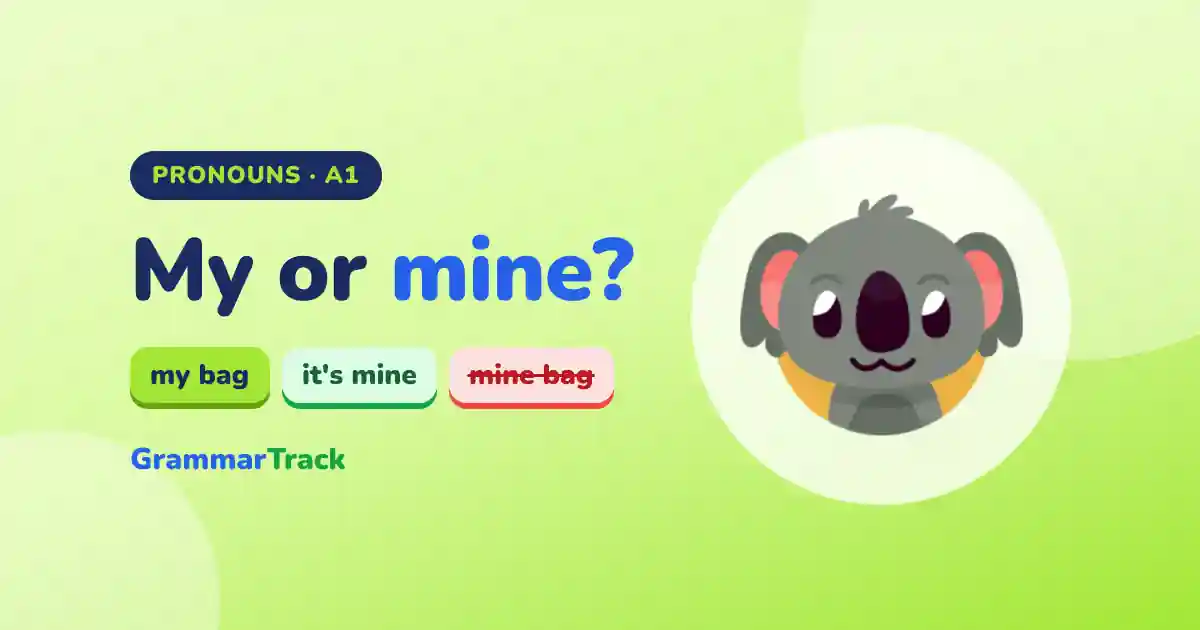
Is this your pen? No, mine is blue. Two short words, two different jobs. Your needs a noun after it, mine doesn't. That one difference decides almost every choice between possessive adjectives and possessive pronouns, and it is what this guide is about.
1.What are possessive pronouns?
A possessive pronoun shows who something belongs to and replaces the whole noun phrase, so no noun comes after it. The possessive pronouns in English are mine, yours, his, hers, ours, theirs (and, very rarely, its).
- That umbrella is mine. (= my umbrella)
- Is this seat yours? (= your seat)
- Our garden is smaller than theirs. (= their garden)
A possessive adjective shows the owner too, but it always comes before a noun: my, your, his, her, its, our, their. Many modern grammars call these words possessive determiners, because they sit where a or the would go. Older grammars and some textbooks call both sets "possessive pronouns" and split them into dependent (my) and independent (mine). The names differ, but the rule is the same.
| Person | Possessive adjective (+ noun) | Possessive pronoun (alone) |
|---|---|---|
| I | my phone | mine |
| you (one person or more) | your phone | yours |
| he | his phone | his |
| she | her phone | hers |
| it | its battery | rarely used alone |
| we | our phone | ours |
| they | their phone | theirs |
Notice the pattern: most possessive pronouns are the adjective + -s (your, yours; our, ours; their, theirs; her, hers). Mine is the odd one out, and his is the same word in both columns.
The whole set, the possessive case of the personal pronouns, sits next to the subject forms (I, he) and object forms (me, him) on the personal pronouns and possessive adjectives topic page. This post goes deeper into one question only: my or mine?
2.My or mine? The one-question test
Ask: does a noun come right after the word?
- Yes, a noun follows: use the possessive adjective. This is my bag.
- No, the noun has already been said or is obvious: use the possessive pronoun. This bag is mine.
Here is the test on five sentences:
| Sentence | Noun right after the gap? | Answer |
|---|---|---|
| Is that (your / yours) car? | yes: car | your |
| The red car is (her / hers). | no: car was already said | hers |
| (Our / Ours) is the house on the left. | no: Our is has no noun | Ours |
| I lost (my / mine) keys. | yes: keys | my |
| Can I use (your / yours)? I forgot (my / mine). | no noun after either word | yours, mine |
In short: my + noun = mine, your + noun = yours, her + noun = hers. The possessive pronoun carries the owner and the noun in one word.
3.Where possessive pronouns go in a sentence
Because a possessive pronoun replaces a full noun phrase, it can go anywhere a noun phrase can go:
- As the subject: Mine is the one with the sticker. Theirs were sold out.
- After be: The decision is yours.
- As the object: I forgot my charger, so I borrowed his.
- After a preposition: Put your coat next to mine.
- After than or as: Her essay was longer than ours. Your answer is as good as hers.
- In short answers: Whose phone is ringing? Mine.
One detail learners miss: the verb after a possessive pronoun agrees with the thing it stands for, not with the owner. Mine is red (my bike), but Mine are red (my shoes). Yours is on the table (your key), Yours are on the table (your keys).
4.10 examples of possessive pronouns and possessive adjectives
The possessive adjective is in bold first, then the possessive pronoun that answers it.
- Is this your jacket? No, mine is in the car.
- My parents live in Lyon. Where do yours live?
- His answer was right, and hers was right too.
- We brought our sandwiches, and they brought theirs.
- Their dog barks all night, but ours is very quiet.
- I can't find my pencil. Can I borrow yours?
- That's not her phone. Hers has a green case.
- Your flat is bigger than ours.
- Our team won, and theirs came second.
- The idea was his, but the hard work was hers.
5.Is it correct to say hers?
Yes. Hers is the possessive pronoun of she, and it is correct whenever no noun follows: The blue bag is hers. Is this coffee hers or yours? What is wrong is:
- her's with an apostrophe. Possessive pronouns never have one: hers, yours, ours, theirs.
- hers before a noun: This is hers bag ✗ → This is her bag ✓.
- her at the end with no noun: The bag is her ✗ → The bag is hers ✓.
The same applies to its: it never takes an apostrophe as a possessive. It's means it is or it has. The apostrophe test with its/it's, your/you're, their/they're and whose/who's is in the possessive case section of the pronouns lesson.
6.Its as a possessive pronoun, and the "own" trick
Its works perfectly as an adjective (The company changed its name), but English speakers almost never use it alone. Which bowl is the cat's? This one is its sounds wrong to most native speakers. Repeat the noun instead: This one is the cat's.
Own is useful with every person. It goes after the possessive adjective and makes the ownership stronger: I want my own room. She runs her own business. After of it becomes of my own, of her own: I'd like a room of my own. You can't say an own room or mine own room.
7.A friend of mine: the double possessive
To talk about one of several things someone has, English uses a/an/this/that + noun + of + possessive pronoun:
- She's a friend of mine. (one of my friends)
- Is he a colleague of yours?
- I heard a song of theirs on the radio.
- That's an old habit of his.
The same pattern works with names and 's: a friend of Anna's, a cousin of my husband's. This is called the double possessive, because the possession is shown twice: by of and by mine or 's. Two forms are wrong here:
- a friend of me ✗ (an object pronoun after of)
- a my friend ✗ (a possessive adjective can't follow a)
Why not just say my friend? My friend Tom points to one particular friend. A friend of mine means one of several, and it is the natural way to introduce someone the listener doesn't know yet.
8.Can you use two possessives in a row?
It depends on what the two words are.
- Two possessive adjectives before one noun: no. my your book ✗. Join the owners or split the sentence: our books, my book and yours, your book and mine.
- A possessive adjective + a possessive noun: yes. my brother's car, our neighbours' garden, her boss's office. Here my belongs to brother, and brother's belongs to car. Chains like my sister's friend's dog are grammatical, but more than two in a row gets hard to follow.
- Two owners of the same thing: give the 's to the last one. Tom and Anna's flat (one flat they share). With a pronoun involved, put the noun first and the pronoun in its normal form: my wife's and my anniversary, or more naturally, our anniversary. My wife and I's anniversary and me and my wife's anniversary are common in speech but count as mistakes in writing.
9.Possessive adjectives vs possessive nouns with 's
Nouns show possession with 's (Anna's, the teacher's) or just an apostrophe after a plural -s (my parents'). A possessive noun can work like both columns at once:
| Before a noun (like my) | Alone (like mine) |
|---|---|
| This is Anna's coat. | This coat is Anna's. |
| The teacher's desk is by the window. | The desk by the window is the teacher's. |
So if you replace a name with a pronoun, choose the column: Anna's coat → her coat; The coat is Anna's → The coat is hers.
10.Common mistakes with my and mine
- This book is my. ✗ → This book is mine. ✓
- Mine book is on the desk. ✗ → My book is on the desk. ✓
- Is this your's? ✗ → Is this yours? ✓
- The choice is their's. ✗ → The choice is theirs. ✓
- The dog wagged it's tail. ✗ → The dog wagged its tail. ✓
- She is a friend of me. ✗ → She is a friend of mine. ✓
- Maria and his brother came. ✗ (about Maria's brother) → Maria and her brother came. ✓
- I washed the hair. ✗ → I washed my hair. ✓
- Yours car is outside. ✗ → Your car is outside. ✓
- Mine is red (about shoes) ✗ → Mine are red. ✓
Why learners get this wrong
The mistakes above depend a lot on the learner's first language:
- Ukrainian, Russian, Italian, Portuguese and Vietnamese use the same word before a noun and on its own: Ukrainian мій телефон / телефон мій, Russian мой телефон / телефон мой, Italian il mio telefono / è mio, Portuguese o meu telefone / é meu, Vietnamese điện thoại của tôi / cái này của tôi. So This phone is my feels natural. In English the word changes: my phone, but the phone is mine.
- Italian and Portuguese also put an article before the possessive (il mio libro, o meu livro), which leads to the my book ✗. And Italian un mio amico gives a my friend ✗: say a friend of mine.
- French and Spanish choose the possessive by the thing owned, not the owner: French son frère / sa sœur can mean his or her, and Spanish su can mean his, her, its, their or formal your. That's why speakers say Maria and his brother. In English, look at the owner: a woman's brother is her brother.
- German has ein Freund von mir and Dutch een vriend van mij, which become a friend of me ✗. The English pattern needs the possessive pronoun: a friend of mine.
- German, French, Spanish and Italian use an article with body parts and clothes (Ich wasche mir die Haare, Je me lave les mains, Me lavo las manos, Mi lavo le mani), and Ukrainian and Russian usually leave the possessive out (Мию руки, Мою руки). English needs a possessive adjective: I wash my hair, I wash my hands.
11.Possessive pronouns exercises with answers
Do all three sets before you open the answers.
Exercise 1: my or mine? Choose the correct word
- Excuse me, is this (your / yours) umbrella?
- That isn't my coffee. (My / Mine) is the one with milk.
- The Smiths painted (their / theirs) fence green.
- Our flat is nice, but (their / theirs) has a balcony.
- Can I use (your / yours) charger? (My / Mine) is broken.
- Emma forgot (her / hers) keys, so she took (my / mine).
- The cat licked (its / it's) paws.
- Is this bag (her / hers) or (your / yours)?
- He's an old friend of (my / mine).
- These seats aren't (our / ours). (Our / Ours) are in row F.
Answers to exercise 1 (click to open)
- your (the noun umbrella follows)
- Mine (= my coffee)
- their
- theirs (= their flat)
- your, Mine
- her, mine
- its (no apostrophe: it doesn't mean it is)
- hers, yours
- mine (a friend of mine)
- our, Ours
Exercise 2: replace the words in bold with a possessive pronoun
- That is my bike. → That bike is ...
- I like Leo's idea better than your idea.
- Our results were better than their results.
- Is this Anna's scarf or your scarf?
- My shoes are black. What colour are your shoes?
- The decision isn't my decision. It's our decision.
Answers to exercise 2 (click to open)
- That bike is mine.
- I like his better than yours. (Leo's idea becomes his)
- Ours were better than theirs.
- Is this hers or yours?
- Mine are black. What colour are yours? (plural verb: shoes)
- The decision isn't mine. It's ours.
Exercise 3: correct the mistakes
Each sentence has one mistake. Rewrite it correctly.
- This phone is my, not yours.
- Is that coat your's?
- Paolo is a friend of me from university.
- Sophie came with his husband.
- Mine sister lives in Canada.
- The company lost it's biggest client.
- My keys are here. Where is yours?
- I need to wash the hands before dinner.
Answers to exercise 3 (click to open)
- This phone is mine, not yours.
- Is that coat yours?
- Paolo is a friend of mine from university.
- Sophie came with her husband. (the owner, Sophie, is a woman)
- My sister lives in Canada.
- The company lost its biggest client.
- My keys are here. Where are yours? (yours = your keys)
- I need to wash my hands before dinner.
12.Practise possessive adjectives and pronouns
- The personal pronouns and possessive adjectives lesson shows subject, object and possessive forms side by side, with practice tasks you can do in the app.
- For practice on paper, download the pronouns worksheet with answers (PDF): a rule table and five exercises on subject and object pronouns, my or mine, and common mistakes, with an answer key on the last page.
- Possessive adjectives are one of the adjective types in adjectives vs adverbs, and the parts of speech lesson shows where pronouns fit among nouns, verbs and adjectives.