









Adjectives vs Adverbs: How to Tell Them Apart
Adjectives describe nouns, adverbs describe verbs, adjectives and other adverbs. Here is a three-step test to tell them apart, a list of 20 pairs, the linking-verb rule (smells delicious, not deliciously), common mistakes and three exercises with answers.
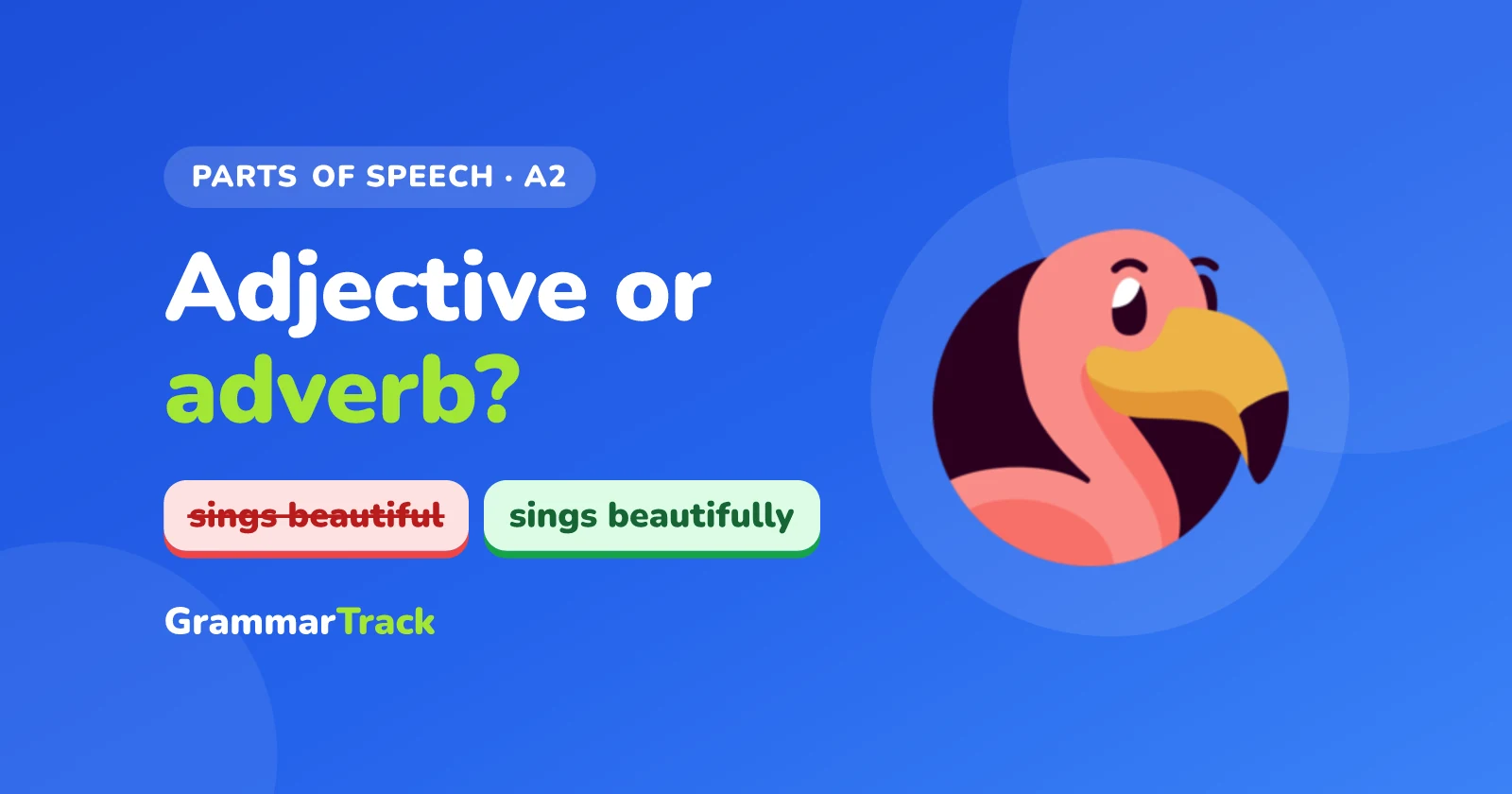
Adjectives and adverbs both describe, which is why they are so easy to mix up. The difference is what they describe. Once you know which word is being described, the choice between quick and quickly, good and well, or bad and badly stops being a guess.
1.Adjective vs adverb: the short answer
An adjective describes a noun or a pronoun: a person, a thing, a place. An adverb describes a verb, an adjective, another adverb or a whole sentence.
| Adjective | Adverb | |
|---|---|---|
| What it describes | a noun or pronoun | a verb, an adjective, another adverb, a sentence |
| Questions it answers | What kind? Which one? How many? | How? When? Where? How often? How much? |
| Where it usually goes | before a noun, or after be, look, feel, seem | after the verb (and its object), or before an adjective |
| Typical endings | -ful, -ous, -ive, -able, -al, -y | often -ly, but not always |
| Example | She is a careful driver. | She drives carefully. |
Both sentences say the same thing about the same person. In the first one, careful describes the noun driver. In the second one, carefully describes the verb drives: how does she drive?
The two words also differ in what they can describe besides their "main" job. An adverb can describe an adjective (a really careful driver) or another adverb (She drives very carefully). An adjective can't do either: a real careful driver is informal American English, and you shouldn't use it in an exam or at work.
2.How to tell if a word is an adjective or an adverb
Don't go by the ending. Friendly ends in -ly and is an adjective; fast has no -ly and can be an adverb. Use this three-step test instead:
- Find the word it describes. Draw an arrow from the word to the word it tells you more about.
- Name that word's part of speech. If the arrow points to a noun or pronoun, you have an adjective. If it points to a verb, an adjective or an adverb, you have an adverb.
- Check with a question. Adjectives answer what kind? or which one? Adverbs answer how?, when?, where?, how often? or how much?
Let's try it on four sentences:
- The old man walked slowly. Old → man (noun): adjective. Slowly → walked (verb), answers "how did he walk?": adverb.
- It was an incredibly hot day. Incredibly → hot (adjective), answers "how hot?": adverb. Hot → day (noun): adjective.
- The test was easy. Easy → test (noun), even though a verb stands between them: adjective.
- We'll meet tomorrow. Tomorrow → meet (verb), answers "when?": adverb.
If you aren't sure what nouns and verbs are in the first place, start with the parts of speech lesson: this test only works when you can spot the word being described.
3.List of adjectives and adverbs: 20 common pairs
Most adverbs of manner are built from an adjective + -ly. Here are 20 pairs learners use every day, with one example each:
| Adjective | Adverb | Example with the adverb |
|---|---|---|
| quick | quickly | She quickly answered the email. |
| slow | slowly | Please speak more slowly. |
| careful | carefully | Read the question carefully. |
| quiet | quietly | The kids played quietly. |
| loud | loudly | He laughed loudly. |
| easy | easily | We won easily. |
| happy | happily | They lived happily in Rome. |
| angry | angrily | She shouted angrily. |
| beautiful | beautifully | He sings beautifully. |
| bad | badly | I slept badly last night. |
| good | well | You did well in the test. |
| polite | politely | He asked politely. |
| clear | clearly | Can you explain it clearly? |
| real | really | I really like this song. |
| serious | seriously | Take your health seriously. |
| sudden | suddenly | Suddenly, the lights went out. |
| gentle | gently | Hold the baby gently. |
| terrible | terribly | I'm terribly sorry. |
| automatic | automatically | The door closes automatically. |
| fast | fast | The train goes very fast. |
The spelling changes in some of them (easy, easily, gentle, gently, automatic, automatically). The full spelling rules with more examples are on the adverbs topic page, in the section on adverbs ending in -ly.
4.Words that are both adjectives and adverbs
Some words don't change at all. The same form works as an adjective before a noun and as an adverb after a verb. This is what people mean by "adverbs as adjectives":
| Word | As an adjective | As an adverb |
|---|---|---|
| fast | a fast car | He drives fast. |
| hard | a hard exam | She works hard. |
| early | an early train | We left early. |
| late | a late dinner | The bus came late. |
| straight | a straight line | Go straight home. |
| daily | a daily walk | The museum is open daily. |
| high | a high wall | The plane flew high. |
| well | I'm not well. (= healthy) | She sings well. |
Watch out: hardly and lately exist, but they mean something else. She hardly works means "she does almost no work", and lately means "recently". So I've been working hard is the hard-working version, and I've hardly been working is the lazy one. The same goes for fastly: that word doesn't exist at all.
The opposite trap is a group of adjectives that end in -ly: friendly, lovely, lonely, lively, silly, ugly, elderly, costly. They have no adverb form, so you use a phrase: She smiled in a friendly way, not She smiled friendlily.
Drive safe or drive safely?
Short adjective forms like safe, slow, quick, real are used as adverbs in casual speech, especially in American English: Drive safe!, Go slow, Come quick! These "flat adverbs" are fine in a text message or on a road sign. In writing, exams and work emails, use the -ly form: Please drive safely, The process runs quickly.
5.After look, feel, smell and taste: adjective, not adverb
This is the rule that catches even advanced learners. A few verbs don't describe an action. They link the subject to a description of it, so the word after them describes the subject (a noun) and must be an adjective.
These linking verbs are be, become, get, seem, appear, look, feel, smell, taste, sound, stay, remain, turn, go (as in go cold):
- The soup smells delicious. (not deliciously: the soup is delicious)
- You look tired. (you are tired)
- This plan sounds good. (the plan is good)
- She became angry. (she was angry)
- The milk has gone bad.
The trick: replace the verb with is or are. If the sentence still makes sense (The soup is delicious), you need the adjective.
When the same verb takes an adverb
Look, feel, smell, taste and sound can also be ordinary action verbs. Then they take an adverb:
| Linking verb + adjective | Action verb + adverb |
|---|---|
| She looked angry. (she was angry) | She looked angrily at me. (she looked at me in an angry way) |
| The cake tastes sweet. | He tasted the soup carefully. |
| I feel bad about it. (sorry, guilty) | He feels his way slowly in the dark. |
Good or well, bad or badly?
Good is the adjective, well is the adverb: She is a good singer, She sings well. Well is also an adjective meaning "healthy", which is why both I'm good and I'm well are fine answers to "How are you?".
Bad is the adjective, badly the adverb: I'm a bad cook, I cook badly. After feel, use bad: I feel bad that I missed your party. I feel badly is common in American speech, but I feel bad is the safe choice.
6.Modifying adjectives and adverbs: very, really, too
Adverbs of degree (very, really, quite, too, extremely, so, pretty, a bit) make an adjective or another adverb stronger or weaker. They go right before the word they modify:
- a very long day (adverb + adjective)
- She speaks really fast. (adverb + adverb)
- It's too cold to swim. (adverb + adjective)
One exception is enough, which comes after the adjective or adverb: Is the room big enough? He didn't run fast enough.
Learners often put very before a verb (I very like it). Very can't modify a verb on its own: say I really like it or I like it very much. More adverbs of degree, with their strength from weak to total, are on the adverbs page.
7.Adjective clauses and adverb clauses
The same split works for whole clauses. A clause is a group of words with its own subject and verb.
- An adjective clause (relative clause) describes a noun. It usually starts with who, which, that, whose, where: The woman who lives next door is a nurse. (which woman?)
- An adverb clause describes the verb or the whole main clause. It starts with a conjunction like because, when, if, although, before, after, until: We stayed inside because it was raining. (why?)
The test is the same as for single words: ask what the clause describes. If it tells you which person or thing, it's an adjective clause. If it tells you when, why, under what condition or in spite of what, it's an adverb clause. The clauses lesson goes through main and subordinate clauses step by step.
8.Types of adjectives and adverbs
Grammar books group them in slightly different ways, but these are the types you'll meet most often.
7 types of adjectives:
| Type | What it tells you | Examples |
|---|---|---|
| Descriptive (quality) | what kind | big, old, red, kind, interesting |
| Quantity | how much or how many | some, many, few, three, several |
| Demonstrative | which one (near or far) | this, that, these, those |
| Possessive | whose | my, your, his, her, our, their |
| Interrogative | asks a question | which, what, whose |
| Distributive | single members of a group | each, every, either, neither |
| Proper | comes from a name | French, Shakespearean, Victorian |
8 types of adverbs:
| Type | Question it answers | Examples |
|---|---|---|
| Manner | How? | slowly, well, hard |
| Time | When? | now, yesterday, soon |
| Place | Where? | here, outside, abroad |
| Frequency | How often? | always, often, never |
| Degree | How much? | very, too, almost |
| Interrogative | asks a question | when, where, why, how |
| Comment (sentence) | What does the speaker think? | luckily, honestly, surely |
| Linking (conjunctive) | How do two ideas connect? | however, moreover, otherwise |
Notice that my, this and which count as adjectives here because they come before a noun. Many modern grammars call them "determiners" instead, and that's fine too: the important point is that they describe a noun, so they never take -ly. If you mix up my and mine, see possessive pronouns vs possessive adjectives.
9.10 examples of adjectives and adverbs in sentences
The adjectives and adverbs are in bold, and the brackets show the word each one describes.
- The little girl smiled shyly. (little → girl, shyly → smiled)
- He always wears black shoes. (always → wears, black → shoes)
- This coffee is too strong. (too → strong, strong → coffee)
- We had a quiet evening yesterday. (quiet → evening, yesterday → had)
- She answered the difficult question easily. (difficult → question, easily → answered)
- Luckily, the last bus was still there. (luckily → the whole sentence, last → bus)
- My new neighbours are really nice. (new → neighbours, really → nice)
- The old printer works perfectly. (old → printer, perfectly → works)
- I rarely read long novels. (rarely → read, long → novels)
- The children were very hungry. (very → hungry, hungry → children)
10.Common mistakes with adjectives and adverbs
These are the mistakes teachers see again and again, from learners of every first language:
- He speaks English very good. ✗ → He speaks English very well. ✓ (it describes speaks)
- The flowers smell beautifully. ✗ → The flowers smell beautiful. ✓ (after a linking verb)
- She sings beautiful. ✗ → She sings beautifully. ✓
- I was terrible tired. ✗ → I was terribly tired. ✓ (an adverb modifies the adjective tired)
- He drove fastly. ✗ → He drove fast. ✓
- She works hardly. ✗ → She works hard. ✓ (hardly means "almost not")
- She smiled friendly. ✗ → She smiled in a friendly way. ✓
- I very like this film. ✗ → I really like this film. ✓
- He is enough old to drive. ✗ → He is old enough to drive. ✓
- Everything went perfect. ✗ → Everything went perfectly. ✓ (went is an action here: how did it go?)
Why learners get this wrong
Many languages use the same word for both jobs, so English feels like it has one form too many:
- German and Dutch use the plain adjective as an adverb: Sie singt schön / Ze zingt mooi. Speakers often say She sings beautiful. In English, the -ly is required.
- French, Spanish, Italian and Portuguese do have adverb endings (-ment, -mente), but in everyday speech they often use the short form too (parler fort, hablar claro). That makes speak loud feel natural. In formal English, use loudly and clearly.
- Ukrainian and Russian make adverbs with -о/-е (гарний, гарно; хороший, хорошо), so the idea is familiar. The trap is the linking verbs: the Ukrainian гарно пахне / Russian хорошо пахнет is built with an adverb, which leads to It smells nicely. English needs the adjective: It smells nice.
- Vietnamese puts the describing word after the verb with no change (hát hay), so learners write She sings good. Remember: an action needs well.
11.Exercises: adjective or adverb?
Try all three sets before you open the answers.
Exercise 1: choose the correct word
- The children were playing (quiet / quietly) in their room.
- Your plan sounds (good / well) to me.
- He finished the race (easy / easily).
- I'm (real / really) sorry about yesterday.
- This soup tastes (strange / strangely).
- Maria is a (careful / carefully) driver.
- They looked (angry / angrily) at the waiter.
- She can't see very (good / well) without her glasses.
- The new teacher seems (nice / nicely).
- We have to work (hard / hardly) this week.
Answers to exercise 1 (click to open)
- quietly (how were they playing?)
- good (linking verb sound)
- easily
- really (it modifies the adjective sorry)
- strange (linking verb taste)
- careful (it describes the noun driver)
- angrily (an action: they looked at him in an angry way)
- well
- nice (linking verb seem)
- hard (hardly would mean "almost not")
Exercise 2: adjective or adverb? Find the word it describes
Say whether the word in bold is an adjective or an adverb, and name the word it describes.
- The heavy rain stopped at noon.
- She suddenly stood up.
- It was a surprisingly short film.
- Our flight was late.
- The train arrived late.
- He is a friendly man.
- They visit their grandmother weekly.
- You did that extremely well.
Answers to exercise 2 (click to open)
- adjective → rain
- adverb → stood up
- adverb → short (an adjective)
- adjective → flight (after the linking verb was)
- adverb → arrived
- adjective → man (an -ly adjective)
- adverb → visit
- adverb → well (another adverb)
Exercise 3: correct the mistakes
Each sentence has one mistake. Rewrite it correctly.
- My brother speaks Spanish fluent.
- The pizza smells deliciously.
- She smiled at me friendly.
- I was incredible lucky to get a ticket.
- He worked hardly all year, so he passed with top marks.
- Please drive careful, the road is icy.
- You look really well in that jacket.
- The film was enough good to watch twice.
Answers to exercise 3 (click to open)
- My brother speaks Spanish fluently.
- The pizza smells delicious.
- She smiled at me in a friendly way.
- I was incredibly lucky to get a ticket.
- He worked hard all year, so he passed with top marks.
- Please drive carefully, the road is icy.
- You look really good in that jacket. (You look well would mean "you look healthy")
- The film was good enough to watch twice.
12.Practise adjectives and adverbs
The fastest way to stop mixing them up is to make the choice many times in real sentences:
- The adverbs lesson has examples of every adverb type, the -ly spelling rules, adverbs of degree and practice tasks you can do in the app.
- For a printable version, download the adverbs worksheet with answers (PDF): five exercises on types, -ly spelling, word order and degree, with an answer key.
- To see where adjectives and adverbs fit among nouns, verbs and prepositions, go through parts of speech.